Every conversation about housing in Negril opens with the same line. There is no land. There is a great deal of land. I can tell you how much, where it sits, who is behind on it and by how many years, because it is all in the government's own records. What there is not is land anybody can buy.
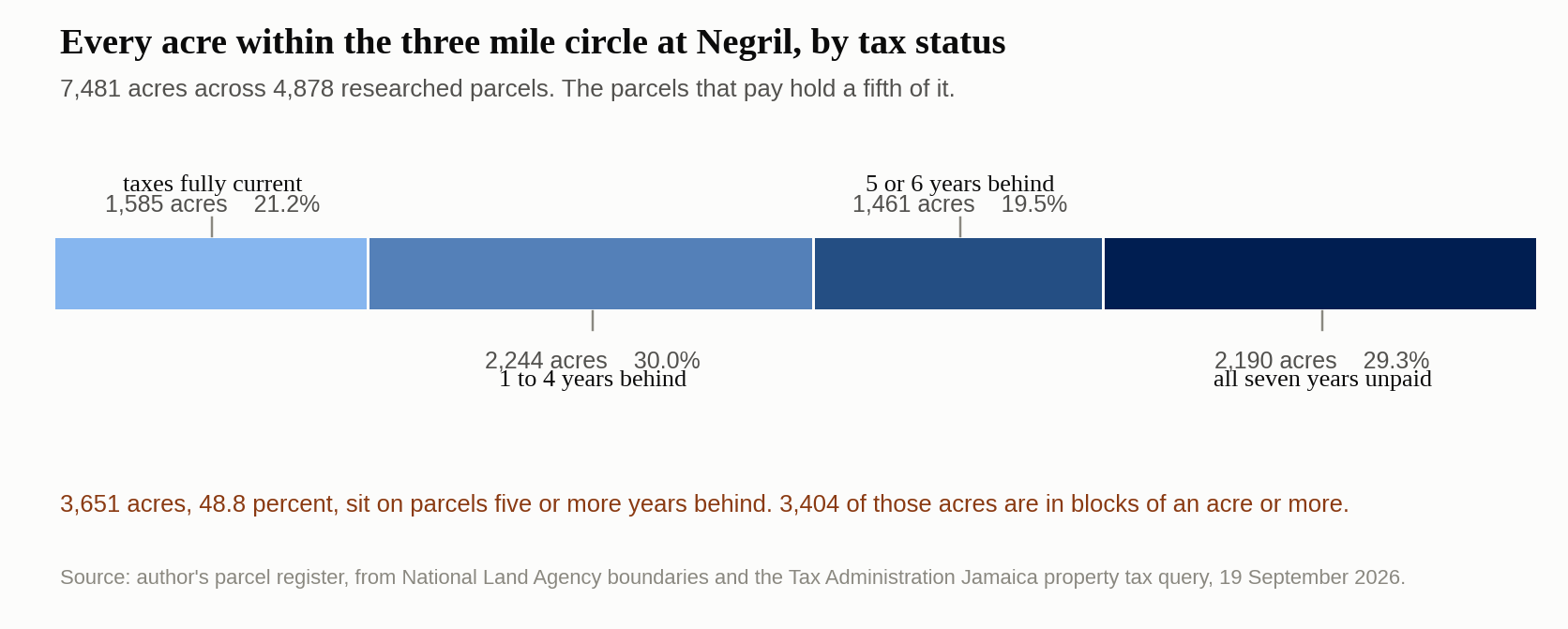
Inside that three mile circle the researched parcels cover 7,481 acres. Of that, 3,651 acres sit on parcels five or more years behind on property tax. That is 48.8 percent. Strip out the house lots and count only holdings of an acre or more, the blocks that could carry a road, a water line and more than one building. That comes to 3,404 acres. Forty five percent of all the land inside the circle is held in blocks by people who have not paid property tax in at least five years. Eight hundred and seventy two of those acres lie inside the innermost mile.
Set that against the other end. The 1,488 parcels whose taxes are fully paid account for 1,585 acres. Twenty one percent. The people who pay hold a fifth of the land. The people five or more years behind hold nearly half. And 2,190 acres, twenty nine percent of everything inside three miles, sit on parcels where every one of the seven years the query shows is unpaid.
Before anyone calls that outrageous, understand that it is rational. The annual tax on those blocks works out at 0.79 percent of their own assessed land value. The median block is 2.35 acres and carries a charge of about J$43,000 a year. Across five to seven years of non payment the arrears reach 5.01 percent of what the state itself says the land is worth. Five percent, once, to hold a piece of the Negril coast through a generation of price growth. Then the oldest year falls out of the window and is extinguished. Then the year after that, and the year after that. The long run cost of holding Jamaican land out of use does not settle at one percent a year. It goes to zero.
Given enough time, a rule like that produces a belief. Ask around this parish what real estate investment means. A good number of people will describe something with no building, no tenant, no permit and no plan. It means buying a piece of ground and holding it. Sometimes for decades. Sometimes across two and three generations. I am not talking about the family farm, or the house somebody's grandmother built that her grandchildren still sleep in. Both of those deserve the protection I argued for in the last part. I am talking about the large unproductive tract held by somebody who has never worked it, does not live on it, and does not intend to. For that holder the asset carries no cost at all. The return is whatever the country's growth adds while he does nothing.
Think how strange that is. There is no other asset in Jamaica you can hold for free. A brokerage account charges a fee, small but real, just to keep the record and mail you a statement. A mutual fund takes its management charge whether it earns you anything or not. A car carries registration and insurance. Even a bank account has its fee. Every one of those is a charge for the simple act of holding a thing, and every one of them gets paid. Land is the exception. The state assesses the charge. The holder declines to pay it. At seven years the state cancels that year in full, then the next year, then the year after that, for as long as he cares to keep not paying. It is the only asset class in this country where the cost of ownership has been legislated down to zero for anybody willing to be patient.
Somebody still pays for the road past that tract. Somebody pays for the schoolbook, the water line, the health center and the salary of every public officer in the parish. It is the neighbors. It is the household that does pay its property tax. It is the shopkeeper paying GCT on everything he stocks, and the worker paying duty on the refrigerator he saved a year for. They carry the cost of the place. Every improvement they pay for lifts the value of the land beside them that put in nothing.
The valuation roll knows this perfectly well. Those idle blocks are assessed at about J$1.4 million an acre. The parcels whose taxes are current are assessed at about J$4.5 million an acre. The state's own numbers tell land that is doing something apart from land that is not. It simply does not act on the difference.
That is the arrangement, and nobody broke a rule to get here. Every holder described above is doing what the law permits and what the law quietly encourages. The fault is not in the people who took the offer. It is in a state that keeps making it.
In the next part, who actually owes this money. The reflex is to picture a country full of householders dodging a bill. That is not what the record shows, and the difference matters more than almost anything else in this series.