In the second part I set out how much land around Negril is held by people who pay nothing to hold it. Three thousand four hundred acres in blocks of an acre or more. Forty five percent of everything inside the circle. Carried at under one percent of its own assessed value a year, and at nothing once the seven years have run. This part is about what that costs the rest of us.
A market where nearly half the supply sits with people under no pressure to sell is not really a market. Of the 4,878 parcels inside three miles, 42 carry an active listing. Under one percent. And 20 of those 42 are themselves two or more years in arrears. So even among the sellers, about half are people who have to sell rather than people who chose to. When supply is that thin, price stops following what land is useful for. It starts following the fact that almost none of it is available. Every acre held idle raises the price of every acre that moves.
That price is paid by people who own nothing. It is paid by the cook, the housekeeper, the gardener and the driver who staff the hotels on this coast. They commute in from further inland every year, because there is nothing near the work they can afford. They pay it in rent, in fare, and in the hour before the shift and the hour after it. And it is not only housing. The shop, the workshop, the small apartment building, the clinic, the mechanic. None of them can open on land nobody will sell. A town cannot thicken if it cannot buy ground.
Put a number on it, and keep it conservative. Take only the 872 idle acres in the innermost mile. Suppose a tenth of that came to market. That is 87 acres. Suppose it were built modestly, at eight homes to the acre, which means small lots and low walk ups rather than anything anybody would call a tower. That is roughly 700 homes, within walking distance of the strip. I am not claiming tax is the only obstacle. I am not claiming every acre would be built well or quickly. Planning, infrastructure, water and title all stand in the way. But 700 homes is the scale of what is being sat on within a mile of the Lighthouse road, and nobody is counting it.
Here is the part that should offend anybody who pays. The write off does not just fail to punish the holder. It rewards him, and it rewards him against the neighbor who paid. Picture two men who buy adjoining acres in 2014. One pays his tax every year. The other pays nothing at all. By this year the first has paid twelve years of property tax, about J$516,000 on a typical block. The second owes seven years, about J$301,000, and will never owe more for as long as he lives, because everything older has been extinguished. Both men's land has risen by the same amount. When they sell, into a market made expensive partly by the second man's refusal to sell earlier, the second man walks away with the better return on the same asset. We have built a system where the most profitable thing to do with Jamaican land is nothing at all with it. The state underwrites that choice by statute.
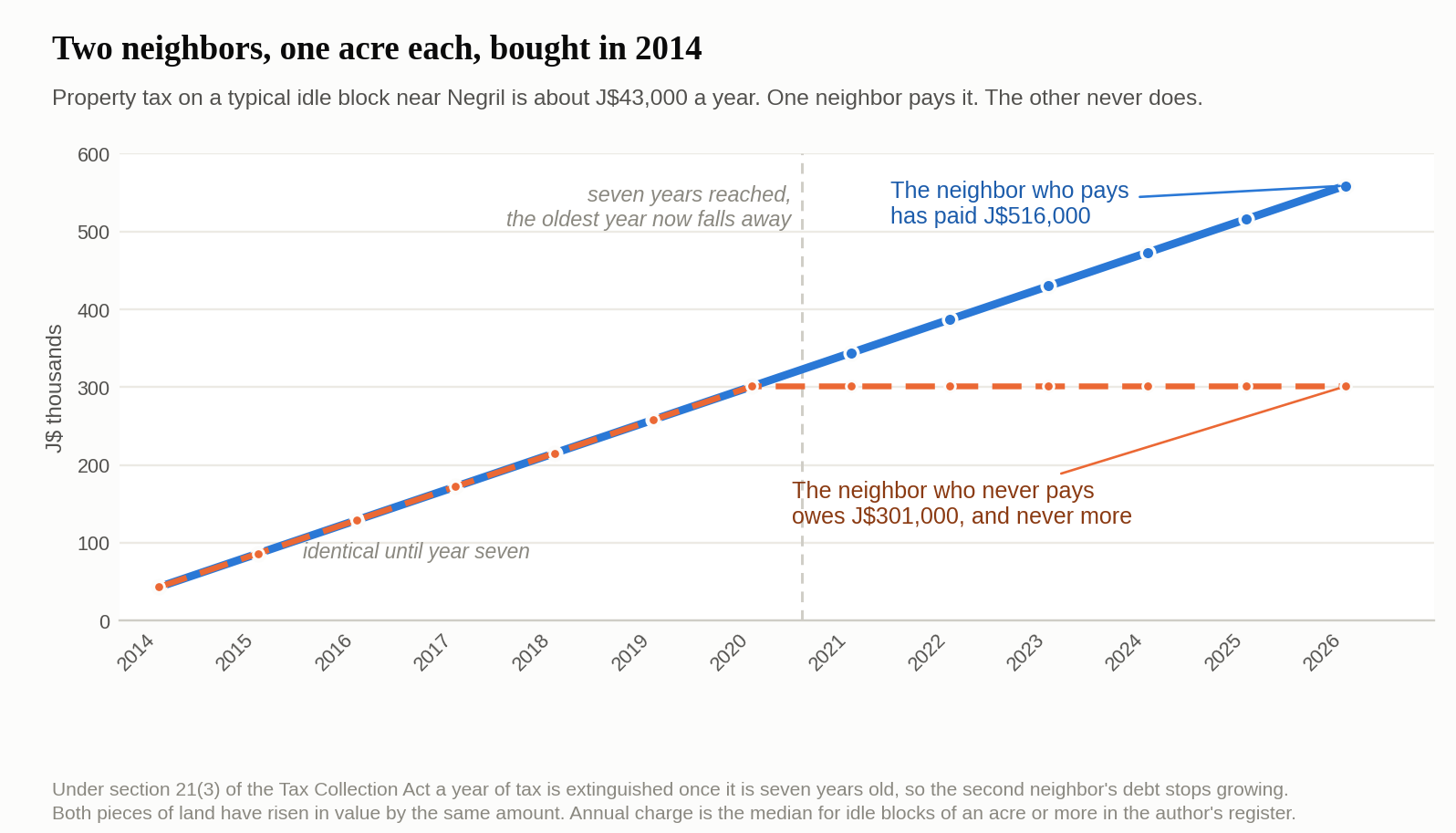
The objection is predictable. Taxing idle land harder will not conjure housing into being, and any cost gets passed along. In a normal market that argument would carry weight. This is not a normal market. Land here is not withheld because holding it is expensive and selling is unattractive. It is withheld because holding it is free. The point of enforcing the assessment is not really revenue. It is to make doing nothing cost something, so that some part of 3,400 acres reaches people who intend to use it.
Put it positively, and this is the whole exercise. Collect the assessment the state has already made. Close the seven year escape on land that is nobody's home. A good deal of this would come to market rather than sit. Some of it would become houses. Some would become shops and small apartment buildings and somewhere for a mechanic to work. The parish would get the roads and the water the tax was raised for. The taxman would get paid. And a hotel worker in Negril might find somewhere to live within reach of the job. Not one of those outcomes needs a new tax. All of them need collecting the one we already have.
Which brings the argument back to the increase coming on the first of April 2027. This is the point where somebody usually starts arguing about who ought to carry it. That is not the argument here. The objection is not the rate. It is that the country may not have needed to impose it at all, and that of everything it could have made more expensive, it chose the one export it actually has. A tax rises because a gap has to be closed. Nobody has yet shown that this gap would exist if the state had collected what it already assessed, in the years it assessed it. Instead it declined to enforce. Then it cancelled the debt at seven years. That is not a complaint about margins. It is a question about whether a new burden was necessary. It has gone unanswered, because the figures that would answer it have not been published since 2016.
Then think about who is being asked to carry it. A visitor's spending is outside money. It arrives from somewhere else and it is earned by somebody here. It passes straight into wages, farm produce, craft stalls, taxi fares, the shop and the supplier. And into the tax at every step. Making that money more expensive to bring into the country is a strange way to close a hole in the accounts. Meanwhile a second group takes the benefit of every hour of that work and puts nothing toward it. The holder of four hundred idle acres employs nobody. He supplies nobody. He repairs no road and funds no classroom. He holds. And while he holds, the people around him get up early, do the work, and raise the value of the thing he is holding. Every improvement this country manages to make, he is paid for. He pays for none of it.
So charge the taxes, and then collect them. That is the whole demand. For the Jamaican living in his own home on his own ground: protection, and deferral in old age, exactly as I argued two parts ago. For everybody else who is not a homesteader, two outcomes and no third. Pay what has already been assessed, with interest and with no seven year escape. Or let the land go back into circulation, so that somebody who will use it can buy it. Those are not harsh terms. They are the ordinary terms that attach to every other asset a person can own in this country. And they would put land, work and revenue back into the hands of the people who actually live here.
In the last part I will set out what collecting it could look like, from the step that costs nothing to the step that needs Parliament.