In the first part I said the parcels inside the three mile circle around the Negril Point Lighthouse carry J$489.5 million in unpaid property tax. The next question is who owes it. The answer matters, because the reflex is to picture a country full of householders dodging a bill. That is not what the record shows.
Start with how ordinary arrears are. Of the 4,878 parcels, 2,593 are two or more years behind. Fifty three percent. The Auditor General found seventy nine percent nationally. So being behind on property tax in Jamaica is not strange behavior. It is normal behavior. A policy that treats every delinquent as a wrongdoer will be both unjust and useless. What matters is not whether an owner is behind. It is what they hold, how much of it, and whether anybody lives on it.
So sort by land instead of by headcount, and the picture turns over. Most parcels here are small. Some 3,007 of them are under a quarter acre, and 4,067 are under an acre. Those 4,067 parcels are eighty three percent of the count and eleven percent of the ground. At the other end, 46 parcels of more than twenty acres hold 4,189 acres between them. That is fifty six percent of all the land inside three miles, in forty six hands.
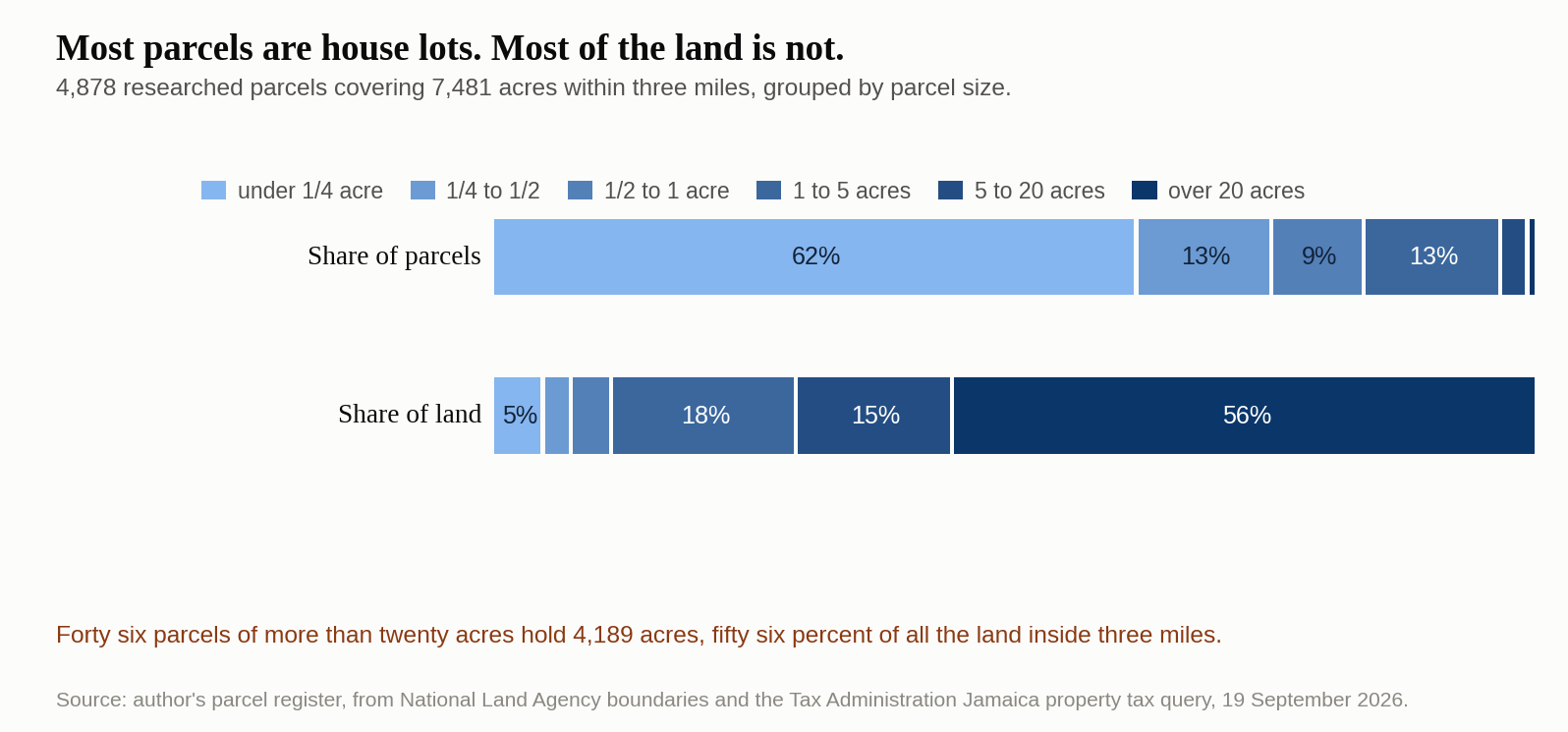
Be careful with the arrears figure, though, because it does not follow the land. The small lots under an acre carry J$195.9 million, which is forty percent of everything owed. This is not a story where only the wealthy are behind. Plenty of ordinary households are. It is a story about where the land is. The blocks of an acre or more carry J$293.7 million and nearly all the acreage.
Inside the innermost mile the same shape appears. There are 370 parcels covering 1,290 acres. The 108 that lie between one kilometer and one mile hold fifty eight percent of that acreage and forty eight percent of those arrears. That outer band is where the West End stops dividing into small cliffside lots and opens into large blocks inland.
Widen to three miles and a few holdings stand out. One private holder carries 24 parcels totaling 547 acres with J$21 million outstanding. That includes a single 369 acre block, six years unpaid. Another holds one parcel of 416 acres, six years unpaid. A company holds 284 acres, seven years unpaid. A 200 acre block at Providence, four hundred meters from my boundary, is unregistered and five years unpaid. Five parcels held in one family group, 52 acres between them, carry J$25 million across two to seven years. None of that is a family behind on a house.
One more pattern recurs across Negril. A single company holds 85 separate parcels amounting to just 31 acres, and carries J$15.6 million in arrears. That density is the mark of a subdivision where the developer sold some lots and kept the rest, paying nothing since, waiting. Multiply that across the coast and a good part of the explanation appears.
Ownership tells you less than people assume. Of the 4,878 parcels, 754 have an owner mailing address outside Jamaica. That is 411 in the United States, 94 in Canada and 90 in the United Kingdom. It proves nothing on its own. A Jamaican nurse in Brooklyn who keeps her mother's half acre and falls behind is not a speculator, and the address on a valuation roll is often years out of date. A foreign address is a question, not a verdict. Scale is the thing that is not ambiguous. A quarter acre lot with a house on it and four years of arrears is a family under pressure. Four hundred acres held from abroad with seven years unpaid is a position.
Understand why holding that position makes sense, because nothing here is fixable until you do. Section 21 of the Tax Collection Act makes the property tax a first charge and lien on the land itself, rather than a personal debt of the owner. In ordinary practice that means no sale completes and no bank lends until the arrears are cleared, because the charge attaches to the property a buyer is buying. That sounds severe. Look at what it means for the holder. The debt cannot grow past seven years, because section 21(3) extinguishes everything older as it ages out. It costs nothing to carry. It comes out of the closing statement whenever he chooses to sell. By then the market has set the price. It rose the whole time he paid nothing toward the roads, the water and the schools that made the spot worth buying. The state never decided to do this. But it has written every idle landholder a free option on the country's growth.
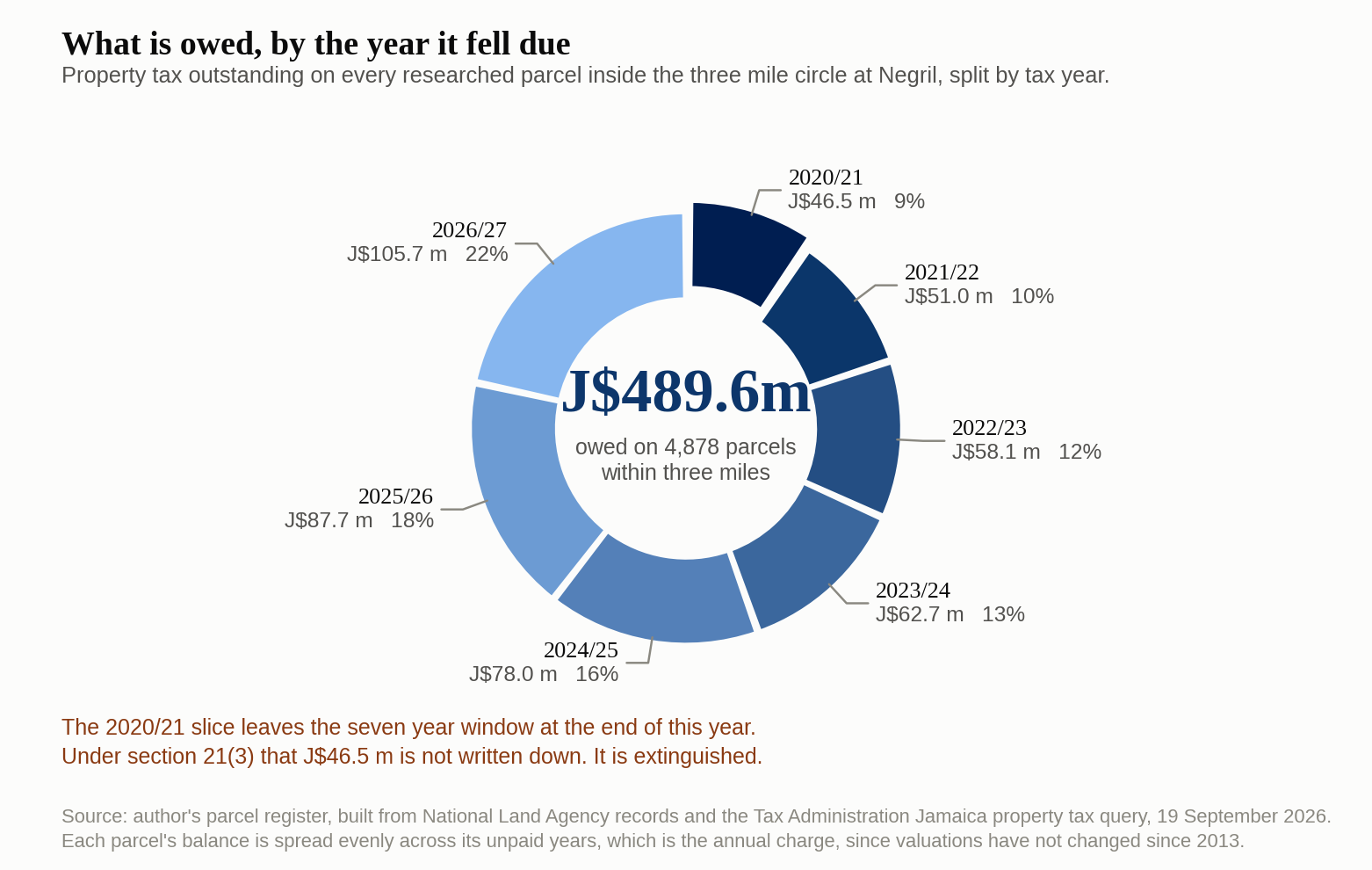
There is one more way to look at the same J$489.5 million, and it shows the machinery at work. Split the total by the year each charge fell due. The current year, 2026/27, accounts for J$105.7 million. The year before it, J$87.7 million. Then J$78.0 million, J$62.7 million, J$58.1 million and J$51.0 million. At the far end sits 2020/21, the oldest year the query still shows, holding J$46.5 million. The curve falls as the years age, because some people do settle and payment goes to the oldest year first. It does not fall to zero. Tax raised on land around Negril in 2020/21 is still unpaid six years later. At the close of this financial year it leaves the window. Not written down. Extinguished, on land that is still there and still rising in value. That is one corner of one parish, and nobody publishes the national figure.
One group complicates the picture honestly. Of those 4,878 parcels, 733 have no registered title at all. Inside the innermost mile it is 163 of 370. Much of that is family land handed down without probate for three generations, where nobody pays because nobody can prove they are entitled to. Those owners are not evading anything. They are stuck. The same state that will not collect the tax has never made it affordable to fix a title. Another 133 parcels sit in estates, which is the same problem wearing a suit. Treating any of them like the holder of a 400 acre block would be both wrong and useless.
A last number, because it shows the system is sedated rather than frozen. Of all 4,878 parcels, 42 carry an active listing for sale. Twenty of those 42 are also two or more years in arrears. Those are owners who have already decided to sell and who must clear the arrears to finish. Land moves when somebody wants it to move. It does not move when nobody has a reason.
So the arrears are not one thing. They are a set of large idle holdings that learned the system has no teeth. They are a great many ordinary families a year or two behind. And they are a layer of land nobody can legally claim. Each needs a different answer. Lumping them together is how thirty years of reform proposals have died.
In the next part I will set out what a fair rule looks like, starting with a protection that ought to exist and does not.