On the first of April 2027 the General Consumption Tax on tourism accommodation rises from ten percent to fifteen, and the Ministry of Finance expects J$11.4 billion a year from that one change. Now set that date beside the day before it. On the thirty first of March 2027 a full year of already assessed property tax stops being recoverable from anybody in Jamaica. It is not written down as a loss. It is erased. Two consecutive mornings. On the first the state takes more. On the second it gives up money it had already billed and recorded. And the thing being made dearer is the one thing this country reliably sells. In the first six months of 2025, on the Tourism Minister's own figures, visitors brought in US$2.4 billion. There are two ways to close a gap in a country that lives on visitors. Raise the price of the visit, or collect the tax you already charged on land that is going nowhere. Jamaica has chosen the first and has not seriously tried the second. I moved to Negril not long ago and bought a house here. What I had was time and an internet connection, and I started reading what the government publishes about the land around me.
The ground I looked at is a circle of three miles' radius over the Negril West End, struck from a point on the West End road a little over half a mile from the Negril Point Lighthouse. Inside it sit 4,878 parcels of land, and together they owe J$489.5 million in unpaid property tax. That figure did not come from a leak or a rumor. I built it from two things the government publishes. The National Land Agency posts the boundary, the valuation number and the owner of every parcel on the island. Tax Administration Jamaica runs a query that tells anyone what is owed on a parcel, and for how long. Every number in this series can be checked by a reader with a laptop and some patience.
Read that figure again. The size is not the point. The point is that the state already agrees with it. Those taxes were assessed. Somebody struck a valuation, applied a rate, raised a bill and opened an account. Nobody disputes the debt. The state simply does not collect it.
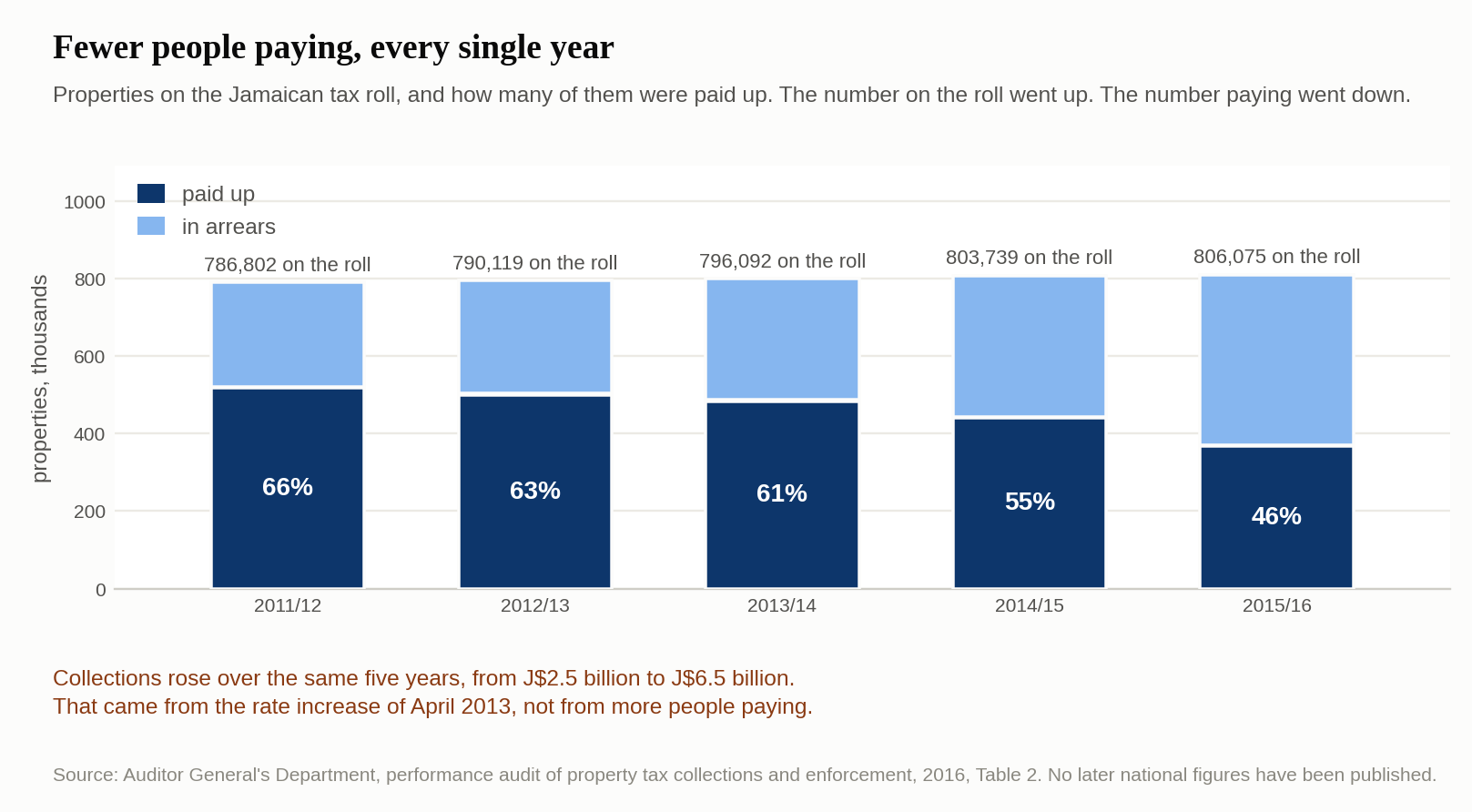
This is not a Negril problem. The Auditor General examined property tax collection in 2016. At May 2014, J$13.5 billion stood outstanding across 631,170 accounts. That was seventy nine percent of every property on the tax roll. In the 2015/16 year the books carried a total obligation of J$15.29 billion. Against that the tax office collected J$6.51 billion. Its collection rate averaged forty five percent. Over five years it prepared 28,489 summonses and served 20,018 of them. And between 2011/12 and 2015/16 it wrote off J$3.26 billion, being tax that fell due between 2004/05 and 2008/09.
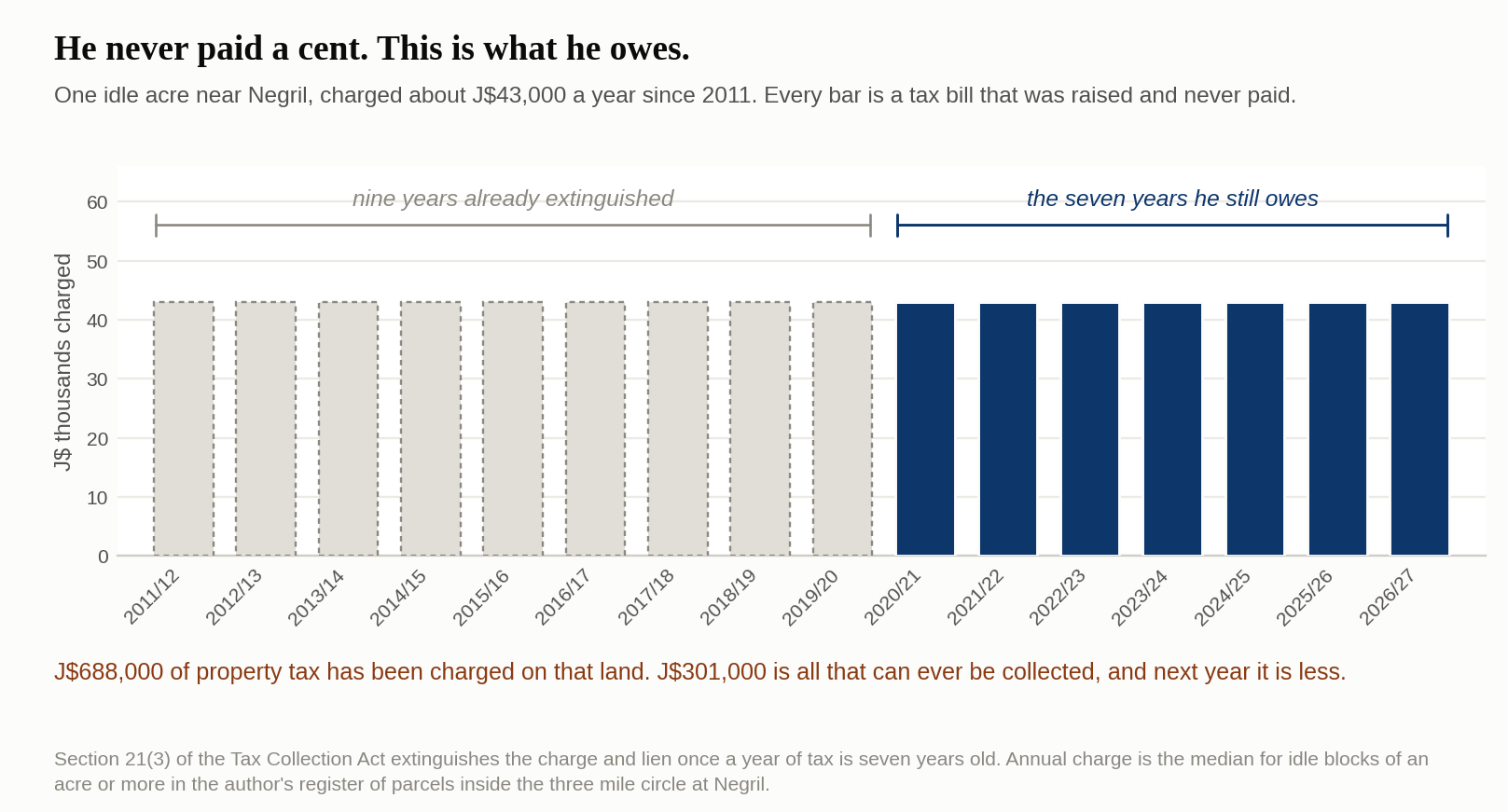
That last phrase deserves attention, because the statute is blunter than the accounting. Section 21(3) of the Tax Collection Act says the tax cannot be recovered from anyone after seven years. It says the charge and lien on the property is extinguished. Not deferred. Not written down. Not carried forward as a note. Extinguished. That is why the public query shows only seven years. The lesson is one landholders learn fast and nobody advertises. The debt has a ceiling, and the ceiling moves forward with you. A man who has paid nothing since 2010 does not owe sixteen years of tax. He owes seven, and he will owe seven for the rest of his life. Meanwhile the land rises in value. When he finally sells, those seven years come out of a price that has grown for a generation. The cost of waiting was zero.
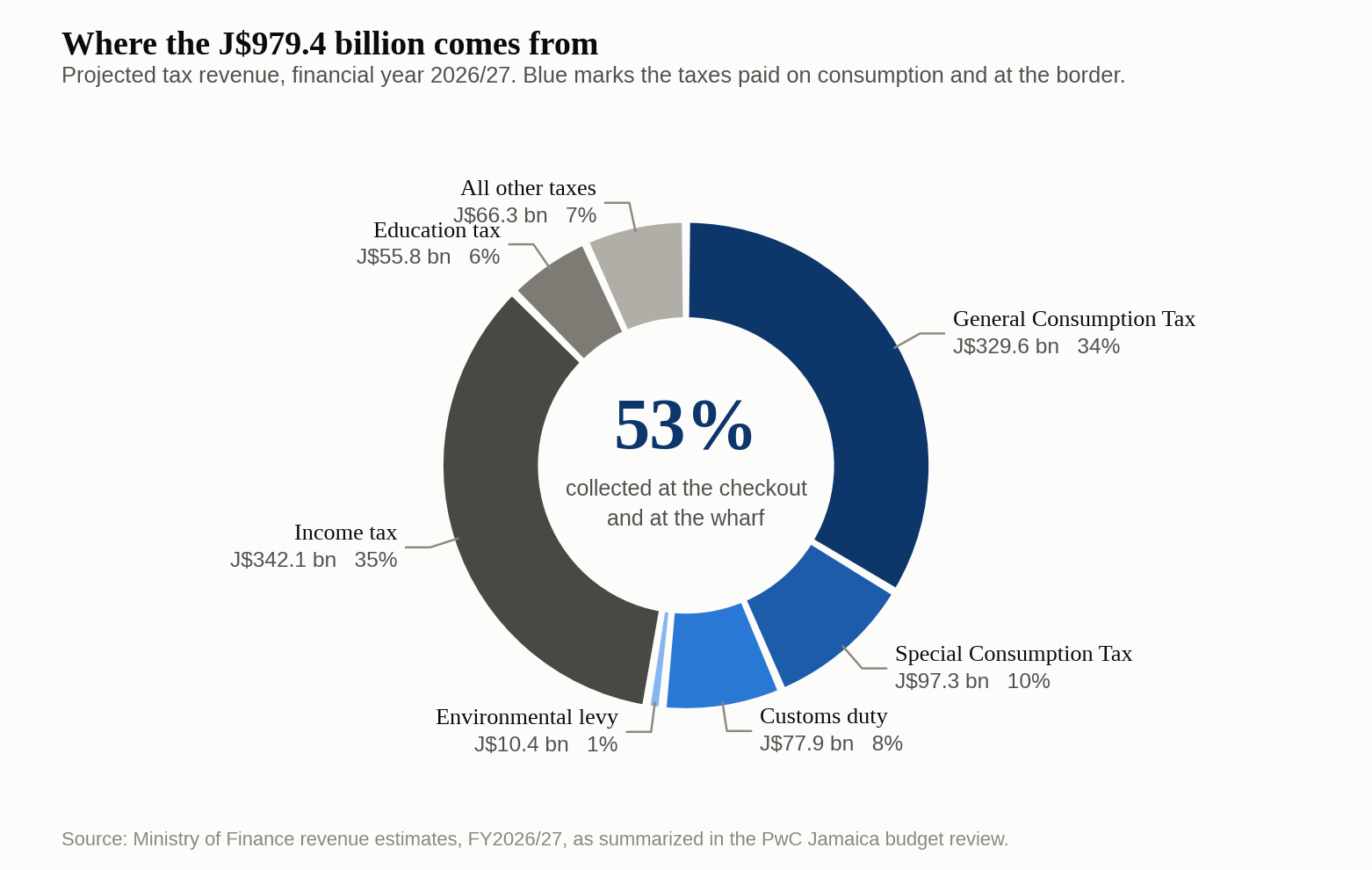
Now look at the budget the country actually runs on. For 2026/27 the government expects J$979.4 billion in tax revenue. J$329.6 billion of that is General Consumption Tax. J$97.3 billion is Special Consumption Tax. J$77.9 billion is customs duty. J$10.4 billion is the environmental levy, which rose this year and now applies to all sales instead of seventy five percent of them. Add the new tax on sweet drinks at J$10.1 billion, more duty on alcohol and more on cigarettes. The picture comes clear. More than half of what the Jamaican state collects, it collects at the checkout and at the wharf.
Those taxes do not care what you earn. The woman buying cooking oil and school shoes pays the same rate as the man with the 400 acre block. She just pays it on a far larger share of what she has. Duty on building material raises the cost of every roof repaired after Melissa. Duty on inputs raises what every supplier in the parish charges, which raises what a visitor pays, which makes Jamaica dearer than the islands it competes with. Consumption tax is easy to collect. That is why governments lean on it. Easy is not the same as fair.
Now the other side of the ledger. Property tax here is still charged on valuations struck in 2013. The National Land Agency began revaluing some 900,000 parcels on the first of July this year. It expects the work to take about twenty months, which puts new bills somewhere in 2028. A 2018 study by the Caribbean Policy Research Institute found that property tax costs about 0.3 percent of revenue to administer. Income tax costs 3.4 percent. So property tax is the cheapest tax we have. It falls on the one asset nobody can move offshore, hide in a shell or drive across a border. And it is the tax we collect least.
Let me be clear about what I am not saying. I am not saying the increase is indefensible on its face. I am not saying the Melissa rebuild can be funded on goodwill. I am not saying the Minister of Finance created this problem. The government put the storm's total loss and damage at J$1.952 trillion. The World Bank and the Inter American Development Bank put physical damage alone at US$8.8 billion. The money has to come from somewhere, and somebody will not like where.
What I am saying is that the order is wrong. Before the state raises a rate on people who already pay, it owes the country a real attempt to collect what it already assessed. Not a press conference. Not another amnesty, which rewards the very behavior it is meant to cure. Collection, published and measured, with the arrears list open to the public the way it is in almost every county in the United States.
Do that first. Publish the result. Then tell me what is still missing, and I will pay my share without complaint. What I object to is being asked to cover a shortfall the state made itself, by declining to collect a bill it wrote. Every Jamaican paying duty on a bag of cement has standing to object to the same thing.
Here is part one in a few lines. The state set the rate. It raised the bills. It recorded the debt in its own books. Then it declined to collect, and after seven years it wiped the debt out. Nobody voted for that outcome. It is simply what the statute produces, year after year, on every parcel in the country. And when the money does not arrive, the gap gets closed at the checkout and at the wharf, by people who very often own no land at all. That is not a tax policy. It is a habit. Habits can be changed, and the first change is a small one.
In the next part, why so little of that money is ever paid. The answer is not in anybody's character. It sits in one subsection of the statute, and it has turned land into the only thing in this country a person can hold for nothing.