If the state is going to assess a tax, it should collect it. If it cannot collect it, it should stop pretending the money exists. Take it off the books, say so publicly, and set a rate that matches reality. What it should not do is what it does now. Carry J$15 billion of receivables that are not real. Write off a few billion every cycle. Then quietly make up the difference from consumption taxes, paid by people with no land at all.
Here is what collection could look like, ordered from what a parish council could do next month to what needs an act of Parliament.
First, publish the list. Every parish council should publish, each year, every parcel two or more years in arrears. Valuation number, acreage, registered owner, amount owed, years outstanding. This is not a name and shame exercise. It is a public register, in the same spirit as the valuation roll, which is already public. Counties across the United States do it as routine and nobody calls it an outrage. Here it would cost almost nothing. The data already sits in the National Land Agency and Tax Administration Jamaica systems. It can be exported. I assembled the Negril portion of it myself with no special access and no training in any of this. If one resident at a kitchen table can produce it, a parish council with a mandate certainly can.
Second, publish the collection performance beside it. Every parish, every year. What was billed. What was collected. How many summonses were prepared, and how many were actually served. How many matters reached a court, and what came of them. It took a formal audit by the Auditor General to establish that 28,489 summonses were prepared and only 20,018 served. That should be an annual line in a public report, not a finding somebody has to dig for. A collection system nobody measures is a collection system nobody runs.
I want to be precise about how little is currently known, because the word publish is doing real work in both of those steps. The Auditor General's audit of 2016 is the last document in which the Jamaican state told the public how much property tax it extinguishes. That series ran J$0.79 billion, J$0.64 billion, J$0.64 billion, J$0.61 billion and J$0.58 billion across the five years to 2015/16. Then it stops. There has been no figure for ten years. Annual collections have not appeared since 2017 either, with one exception. In 2023/24 the municipal corporations received J$9.306 billion in property tax, against a budget of J$10.536 billion. That figure appears in one place only. It is a public financial management assessment, written for the World Bank and the donors rather than for Jamaicans. In the national revenue estimates the property tax head is carried at zero, because the money never enters the Consolidated Fund. The only trace of it is a line of about a quarter of a billion dollars, described as a two and a half percent commission. And then there is the Minister of Local Government. His sector draws close to half its transfers from this tax. He did not use the word property once in either of his last two annual presentations to Parliament.
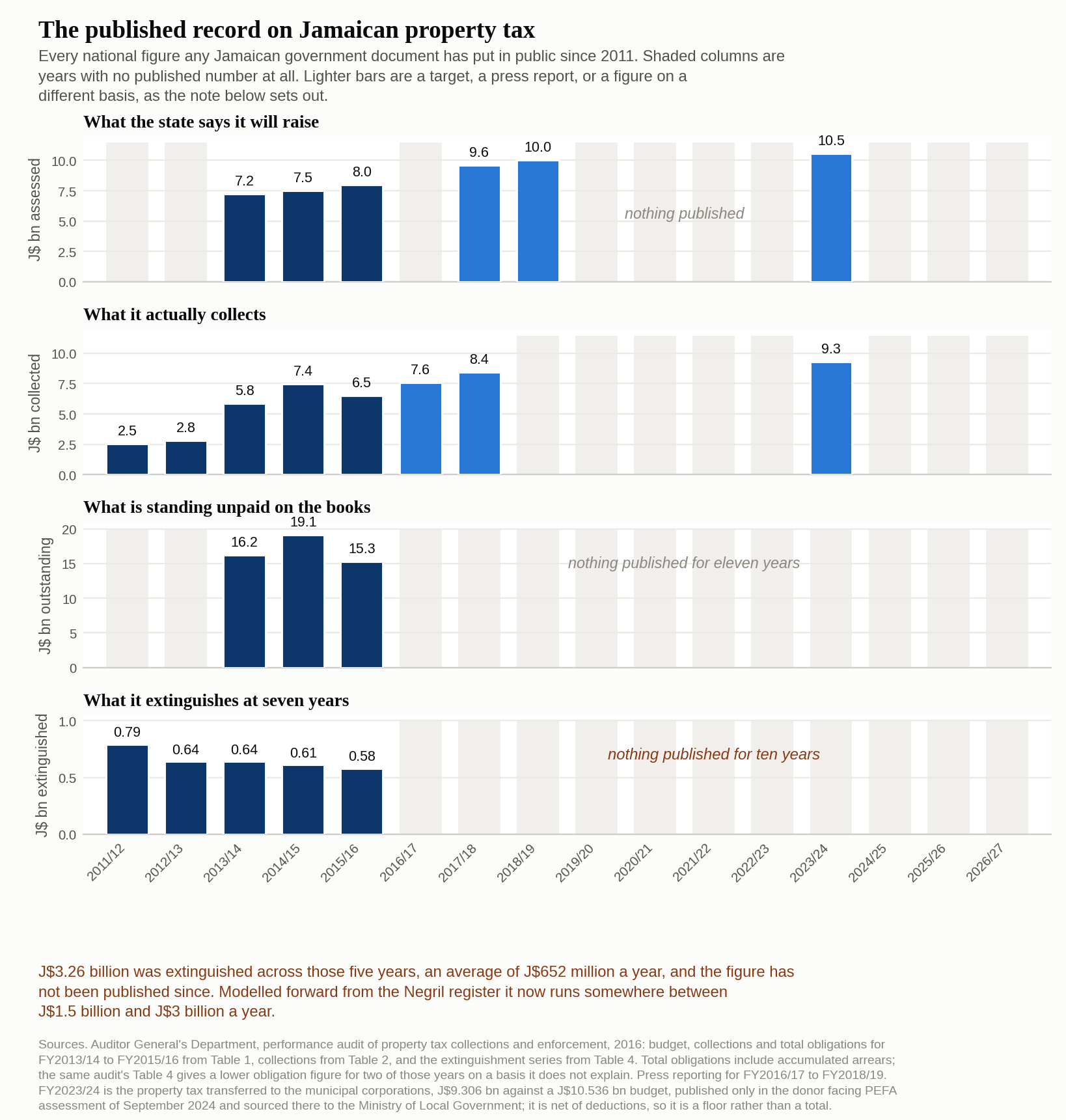
None of that is because the numbers do not exist. Tax Administration Jamaica produced the extinguishment figures for the Auditor General in 2016, out of its own records. And the same assessment that disclosed the 2023/24 transfer names another document. It is a TAJ revenue arrears aging report. An aging report is exactly a statement of what is owed and how old it is. It is compiled every year. It would answer every question in this series at a stroke. It is simply not shown to anybody. A member of Parliament could ask for it tomorrow. So could any citizen, under the Access to Information Act. The refusal would be as instructive as the answer.
Third, end the seven year write off for everything that is not a homestead. Let interest run without a ceiling on land nobody lives on. That one change alters the arithmetic for every idle holding in the country, because the free option disappears and the cost starts to compound. It seizes nothing from anybody. It simply stops paying people to wait.
Fourth, make the sale power work, and tell the country honestly what is actually in force. Jamaica has legislated for the sale of land held by long term defaulters. Amendments announced more than a decade ago were to permit sale after three years of non payment, with open bidding. No citizen can easily establish which of those provisions were ever brought into operation. Or what conditions attach to them. Or how many parcels have ever been sold. That deserves a straight answer from the Ministry of Finance, in writing, because the visible evidence is that nothing sells. Take Coopers Pen in Trelawny. More than 260 acres, J$26.3 million owed, an annual tax bill of J$3.4 million, land valued at J$390 million. In August it was reported still unsold and still tangled. Whatever the statute book says, that is not an enforcement regime in operation. It is a filing cabinet.
Fifth, and only with care, the American lien certificate model. In most American states the county does not sell the delinquent land. It sells the lien, at auction, to an investor who pays the county its money at once. The owner keeps the property. He also keeps a period set by statute, often two or three years, to buy the lien back with interest. So the county gets paid in full in the current year. The owner gets time and a clear price to fix it. Only the small residue nobody ever redeems changes hands. The reason to be careful here is title. A lien sale assumes a reliable register. Jamaica's is incomplete enough that this step belongs last, after the regularization I argued for earlier.
Not one of those five asks the state to be crueler than it is today. Together they would raise a great deal more than J$11.4 billion. It would come from holdings the state's own records already show owing the money. Not one family in one house would be touched.
I have made the argument about who should be carrying this, so I will not make it twice. One practical note belongs on the record all the same. This parish lives on visitors, and the increase arrives while that sector is still repairing itself. At August of this year some 5,648 rooms had not returned to service, about twenty eight percent of the stock Melissa damaged, and roughly fourteen hotels were still closed. Occupancy was running near twenty seven percent at the smaller properties and forty four percent at the larger ones. Those numbers improve month by month. They are still the ground the increase lands on, and every wage in this parish that depends on a visitor stands on the same ground. A country that earns its foreign exchange by being worth the trip is raising the price of the trip. It is doing that instead of collecting a tax it already assessed, on land that cannot be moved, hidden or taken anywhere.
The part I want on the record is this. A consumption tax is paid by whoever is standing at the counter. It reaches the visitor. It reaches the supplier, in the duty on everything brought in. It reaches the woman at the supermarket checkout who has never seen the inside of a hotel. And within three miles of where all of us live and work, J$489.5 million in property tax stands assessed, recorded, undisputed and uncollected. It sits on land that rises quietly in value, in the hands of holders who learned the bill never really comes.
That money was meant for parochial roads, street lighting, solid waste and water. It is more than thirty percent of what a parish council has to spend. You can see its absence in the road surface on the West End. You can see it in the water pressure, and in the schools the children on my road go to. It is not an abstraction and it is not an accounting entry. It is the difference between the Negril in the brochures and the Negril people actually live in.
I am not asking for anybody's rate to be cut. I am asking the government to collect what it has already assessed before it assesses more, and to stop requiring the rest of us to subsidize the decision not to.