Everything so far can be read as an argument for collecting harder. It is not, or not only. A rule that pressed every delinquent equally would fall hardest on the people least able to take it. That is wrong. And in a country where seventy nine percent of properties are behind, it is politically dead on arrival.
What Jamaica lacks is not enforcement. It is a distinction. The law does not care whether the owner of a parcel sleeps on it every night or has never set foot on the island. It applies the same obligation to both, and in practice the same non enforcement to both. A rule that drew that line would protect the people who need protecting. It would also take the shelter away from the people quietly enjoying it.
Four pieces, in order of how obvious they are.
The first is a homestead protection. A Jamaican who owns the home he lives in, on land below a stated value, should get a fixed reduction in his assessment. He should also get an absolute bar on forced sale of that home for property tax alone. Not a waiver granted by application to a council, which in practice means granted to whoever knows whom. An entitlement, claimed once and renewed automatically. Most American states have a version of it and nobody there thinks it radical. It says one simple thing. Shelter is not an investment position and should not be treated as one.
The second is deferral in retirement. A homesteader who reaches a qualifying age should be able to stop paying. The deferred amount is recorded as a charge against the title and settled on sale or out of the estate. The state forgives nothing. It waits, with its claim registered against the one asset that cannot run away. The widow in her house on the hill keeps the house. The parish keeps the money, just later. Several American states run exactly this and the default rates are tiny, because the security is the land itself.
The third is the part nobody will enjoy. Outside the homestead, the protection ends. Large undeveloped tracts. Land held by non residents who do not occupy it. Land in corporate and offshore names. Land held by people who cannot lawfully return to Jamaica. And land held by people who simply worked out that the seven year ceiling makes non payment free. For all of it: full rate, full interest, full enforcement, and no statutory write off. The seven year rule should not apply to any parcel that is not somebody's home. It was meant as an administrative mercy. It has become a subsidy for the holdings least in need of mercy.
Somebody will say the third point cannot be enforced, because the state cannot establish who lives where. New York has just spent a year answering that, and the mechanism is worth studying whatever anyone thinks of the politics of the mayor who pushed it. The city's pied a terre tax took effect on the first of July this year and runs to 2031 unless renewed. It charges extra on homes above a value threshold that are not the owner's main residence. The rates step up with value. A main residence means one the owner occupies. It can also be one rented out on a real lease of at least a year, to an actual person. Ordinary homes sit outside the tax entirely. It is expected to raise between US$340 million and US$500 million a year. It is not a perfect instrument. A hard threshold invites values to bunch just below it. And the definition will be argued in court for years.
The part Jamaica should take is not the rate. It is who has to prove what. The city does not have to show that an apartment is empty. It makes a first determination and asks the owner for evidence. If the owner does not answer by the deadline, that determination is final. It cannot be challenged after that. Put that in a parish council's hands and the problem of the unreachable owner turns over. The council publishes a status for every parcel above a stated value: homestead, let under a registered lease, or neither. The owner gets one window to correct it with documents. Silence is an answer. The parcels that end in the third group become the list, ranked by acreage and value, from which summonses and then sales proceed. Everything in the first group is untouchable. Nobody has to guess who the speculators are, or argue about nationality and intent. The speculators are the people who did not write back.
The fourth piece makes the other three honest. There are 733 parcels around Negril with no registered title, and tens of thousands more across the island. Give them a real route to regularization. A fixed fee. A simple process. A fixed window. And a write off of past arrears on completion, for anyone living on the land who brings the title current. That is the one amnesty I would argue for, because it buys something permanent. A parcel with a clean title can be taxed, mortgaged, insured and inherited for the rest of its existence. Right now those families are locked out of the formal economy by a paperwork problem the state never solved. Then they are blamed for the arrears that follow.
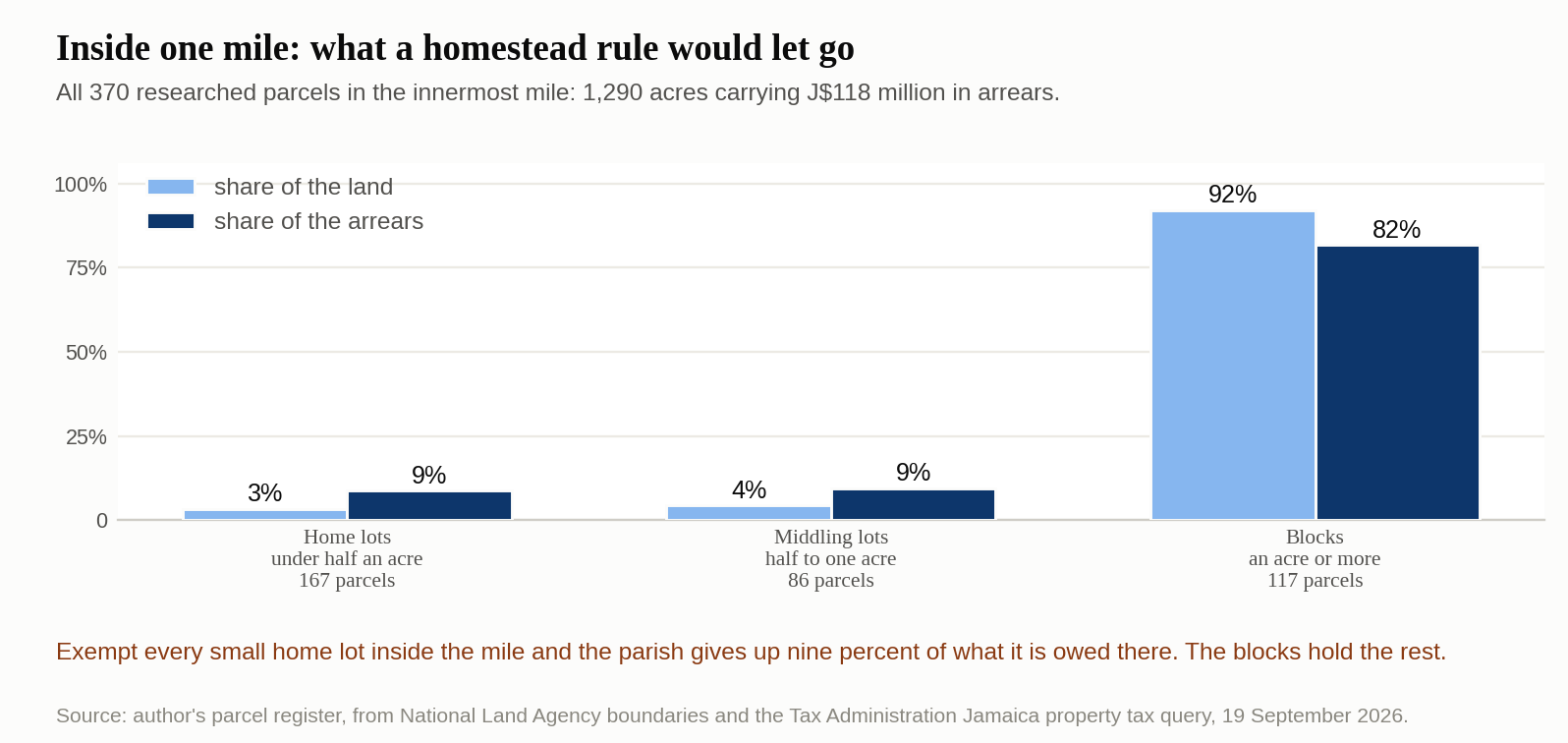
Somebody will ask what a homestead exemption costs. The innermost mile answers it. Inside that first mile there are 370 researched parcels holding 1,290 acres and J$118 million in arrears. The 167 small home lots under half an acre hold three percent of that land. They hold nine percent of those arrears. The 117 holdings of an acre or more hold ninety two percent of the land and eighty two percent of the arrears. So exempt every small home inside that mile, and the parish gives up nine percent of what it is owed there. Collect properly on the blocks and it gains far more back, in the first year.
There is one more argument and it is the one I feel most. A carrying cost that actually bites is not an attack on landowners. It is the ordinary way land reaches the people who will use it, and Jamaica has switched it off. That deserves a piece of its own, and it gets one next.
The current arrangement gets this backwards. The family in the house has no real protection. What they have is informal. It rests on the council not bothering, and that could end tomorrow. The idle tract has total protection, because the write off is in the statute and never fails. We guard the speculator by law and the homeowner by neglect, then make up the difference at the supermarket.
In the next part, what all that held land does to the price of a house lot, and to the people who get up every morning and do the work here.